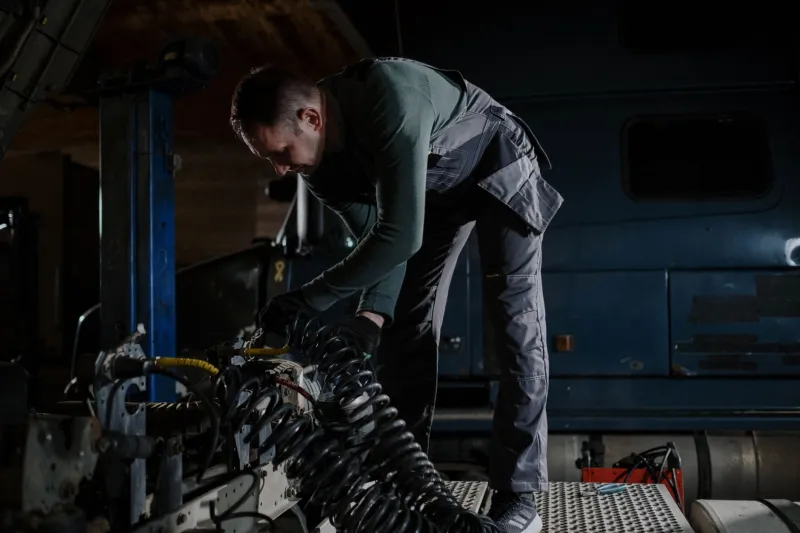
The Part That Costs $40 and Destroys $15,000 Engines: What Fleet Managers Need to Know About Thermostat Failure

If you asked most fleet managers to name the components most likely to cause a catastrophic diesel engine failure, the thermostat probably wouldn't make the list. It's small, it's cheap, and it's easy to overlook. That's exactly why it ends up being responsible for some of the most expensive engine damage in commercial trucking.
Here's the reality: a thermostat that's failing — whether it's stuck open, stuck closed, or just operating inconsistently — disrupts the entire thermal management system of a diesel engine. And a diesel engine that can't regulate its own temperature is an engine that's quietly destroying itself, often while the gauges suggest everything is fine.
How a Thermostat Is Supposed to Work
The thermostat's job sounds simple: regulate coolant flow between the engine and the radiator to keep operating temperature in the optimal range. When the engine is cold, the thermostat stays closed, allowing coolant to circulate only within the engine block to reach operating temperature faster. Once the engine hits the target temperature range — typically around 180 to 195 degrees Fahrenheit in most heavy-duty diesels — the thermostat opens and allows coolant to flow through the radiator to shed heat.
That cycle repeats constantly during operation, making small adjustments to keep the engine in its sweet spot. It's a mechanical process that happens thousands of times over the life of the component, and like any mechanical component under repeated stress, it eventually wears out or fails.
The problem is that thermostat failure doesn't always announce itself clearly. It tends to disguise itself as something else.
The Two Ways Thermostats Fail — and Why Both Are Bad
Thermostats fail in two primary modes, and both cause serious problems — just different ones.
Stuck open means the thermostat never fully closes, so coolant is constantly flowing through the radiator regardless of engine temperature. The result is an engine that runs chronically cool — below its optimal operating range. This is the failure mode that catches a lot of operators off guard because the temperature gauge doesn't spike. The engine looks fine. But a diesel running consistently below operating temperature is burning fuel less efficiently, building up carbon deposits faster, wearing cylinder walls more rapidly, and in colder climates, struggling to generate adequate heat for the cab and DEF system.
Long-term, a thermostat stuck open degrades engine performance and accelerates internal wear. It's a slow-motion problem.
Stuck closed is the one that creates emergencies. When the thermostat won't open, coolant can't circulate through the radiator. Heat builds rapidly. The temperature gauge climbs. If the driver doesn't catch it — or if the warning system is slow — the engine overheats. And a diesel engine that overheats is not forgiving.
The head gasket is typically the first casualty. Head gasket failure in a heavy-duty diesel can run $3,000 to $8,000 depending on the engine and the extent of the damage. If the overheating event is severe enough, you're looking at warped cylinder heads, scored cylinder walls, or in the worst cases, a complete engine rebuild or replacement that can exceed $15,000 to $25,000.
All of that from a part that costs less than a decent lunch.
Why It Gets Misdiagnosed So Often
The symptoms of thermostat failure overlap significantly with other cooling system problems — water pump issues, radiator blockage, coolant leaks, and air pockets in the cooling system can all produce similar readings and symptoms. A driver who reports "the temp gauge was a little high" could be describing a thermostat problem, a low coolant situation, or half a dozen other things.
This is where diagnostic discipline matters. When a cooling system complaint comes in, the thermostat should be among the first things checked — not an afterthought after everything else has been ruled out. A thermostat test is inexpensive and straightforward: remove it, drop it in hot water with a thermometer, and watch whether it opens at the correct temperature. If it doesn't open, or opens at the wrong temperature, you have your answer.
The mistake shops and fleet maintenance teams make is assuming the thermostat is fine and chasing more complex explanations. Weeks later, the driver is back with a blown head gasket, and the original thermostat test that wasn't done is looking like a very expensive oversight.
Coolant Flow Problems Beyond the Thermostat
It's worth noting that the thermostat doesn't operate in isolation. Even a functioning thermostat can't compensate for a cooling system that's compromised elsewhere.
A water pump that's losing efficiency — whether from a worn impeller, bearing failure, or cavitation — reduces coolant flow throughout the system. A partially blocked radiator from scale buildup or debris reduces the system's ability to shed heat even when flow is adequate. Air pockets introduced during an improper coolant flush can create hot spots in the engine block that don't show up on the temperature gauge until damage is already occurring.
Coolant condition matters too. Degraded coolant loses its ability to transfer heat efficiently and can become corrosive, attacking water pump seals, radiator cores, and engine block passages. This is why coolant maintenance isn't just about preventing freezing — it's about maintaining the thermal performance the entire system depends on.
Building Thermostat Checks Into Your Maintenance Schedule
For most heavy-duty diesel applications, thermostats should be inspected or replaced as part of major service intervals — typically every 100,000 to 150,000 miles, or any time cooling system work is being performed. If you're already draining the coolant for a flush, the incremental cost of replacing the thermostat is minimal compared to the cost of pulling the system apart again six months later.
Any time a truck comes in with a cooling system complaint — elevated temps, inconsistent cab heat, longer-than-normal warm-up times — the thermostat should be on the inspection list from the first conversation. Don't let it be the last thing you check.
The engine in a Class 8 truck represents a massive investment. Protecting it from a $40 part failure is about as straightforward a maintenance decision as exists in commercial trucking. The only way it becomes expensive is when it gets ignored.