Rust Never Sleeps: What's Eating Your Truck's Undercarriage and What It's Going to Cost You
There's a joke in the trucking world that rust is just the undercarriage's way of returning to nature. Nobody's laughing when the frame rail cracks on a $150,000 rig, though.
For operators running routes through the Midwest, the Mountain West, or anywhere that sees a real winter, undercarriage corrosion is one of those slow-moving disasters that's easy to ignore right up until it becomes impossible to. Road salt, moisture, exhaust heat cycling, and simple road debris work together to break down protective coatings and eat into metal over months and years. By the time you can see it from a walkaround, the damage underneath is usually far worse than what's visible.
This isn't a scare piece. It's a realistic look at what's happening under your trucks, how fast it moves, and what it costs when you let it run.
Why Undercarriage Corrosion Moves Faster Than You Think
Steel corrodes. That's not news. But the conditions that heavy-duty trucks operate in accelerate the process dramatically compared to a passenger car sitting in a driveway.
Road salt is the biggest culprit in northern and mountain states. Sodium chloride and magnesium chloride — both widely used for ice control — are highly hygroscopic, meaning they pull moisture out of the air and hold it against metal surfaces long after the road dries out. A truck that runs through salted roads in January doesn't just get a quick rinse and come clean. That salt works into crevices, under brackets, around weld points, and into any spot where the factory coating has chipped or worn.
Add in the heat cycling from exhaust components running near frame rails and crossmembers, the constant flex of a loaded truck on rough roads, and the stone chips that knock protective coatings loose, and you've got a recipe for corrosion that compounds on itself.
Most operators see significant visible surface rust within two to three winters of neglect. Structural compromise — meaning the metal has lost meaningful thickness and strength — can follow within another season or two depending on the environment and how hard the truck is working.
What Actually Gets Damaged — and Why It Matters
Not all undercarriage rust is equal. Surface oxidation on a non-structural bracket is annoying but manageable. Rust eating into your frame rails, crossmembers, air brake lines, fuel tank straps, or suspension mounting points is a different story entirely.
Frame rail corrosion is the one that keeps repair shops busy. When the main rails lose structural integrity, you're not just looking at a cosmetic fix — you're potentially looking at section replacement, welding, or in severe cases, a total frame replacement that can run anywhere from $8,000 to well over $20,000 depending on the truck and the extent of the damage.
Air brake line corrosion is a safety issue before it's a repair issue. Corroded brake lines can fail without warning, and in a loaded semi, that's not a situation anyone wants to be in. DOT inspections will catch severe cases, but moderate corrosion that hasn't yet compromised function can fly under the radar until it doesn't.
Fuel tank strap failure is another underreported problem. Those straps hold a significant amount of weight, and when they rust through, the tank doesn't stay in place. It's a roadside emergency waiting to happen.
The Timeline Nobody Talks About
Here's the frustrating part: undercarriage corrosion is almost entirely preventable if you catch it early, and almost entirely avoidable if you maintain it consistently. The problem is that most inspection routines don't include a real look underneath.
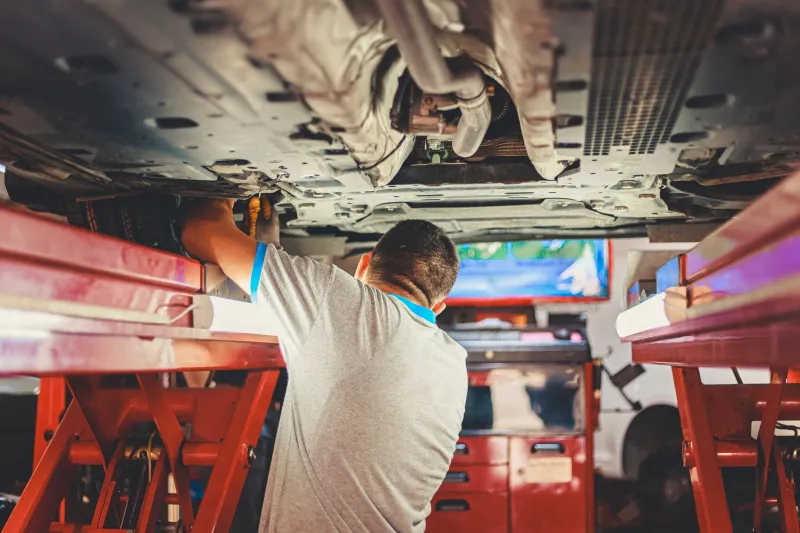
A quick walkaround before a trip isn't going to catch what's developing on the inside of a frame rail or behind a crossmember bracket. You need a lift, a light, and someone who knows what they're looking at.
For trucks operating in high-salt environments, a meaningful undercarriage inspection should happen at least twice a year — once before winter and once after. What you're looking for: paint bubbling or flaking on structural components, visible rust scaling (not just surface discoloration), any moisture traps where debris has packed against metal, and the condition of protective coatings on brake lines and fuel lines.
If you're buying a used truck, an undercarriage inspection should be non-negotiable. A truck that looks clean on the outside can be hiding years of corrosion damage underneath. Get it on a lift before you sign anything.
Preventative Treatment vs. Reactive Repair — The Math Is Simple
Undercarriage coating treatments — rubberized undercoating, oil-based rust inhibitors, or professional-grade spray applications — typically run between $300 and $800 per truck depending on size and product. Annual reapplication in high-exposure environments might double that over time.
Compare that to a frame section repair at $5,000 to $8,000, or a full frame replacement that can exceed $20,000. Even for a single truck, the math is obvious. For a fleet of ten or twenty units, the difference between a proactive coating program and reactive repair budgets is the kind of number that ends careers.
Beyond direct repair costs, there's resale value to consider. Trucks with documented undercarriage maintenance and clean structural inspections command meaningfully higher prices on the used market. Buyers know what they're looking for, and a truck with visible frame rust is going to get hammered on price — if it sells at all.
What to Do Right Now
If your trucks haven't had a real undercarriage inspection recently, that's where to start. Get them on a lift and have someone go through the frame, crossmembers, brake lines, fuel system components, and suspension mounting points with a light and a pick. Document what you find.
If you're seeing early surface rust on non-structural components, clean it, treat it, and coat it. Early-stage rust is cheap to address.
If you're seeing scaling, pitting, or any loss of material thickness on structural components, don't wait. Get a professional assessment and understand the scope of what you're dealing with before it progresses further.
And if your trucks are running through salt country regularly without any undercarriage protection program in place, that's a gap in your maintenance plan that's costing you money every single winter — even if you haven't gotten the bill yet.
Rust doesn't take days off. The undercarriage of your truck is working against you quietly, and the longer it goes unaddressed, the more expensive the conversation gets. Get under your trucks before the rust does the talking for you.