Your Trucks Are Running — They're Just Not Going Anywhere: The Real Dollar Cost of Fleet Idling
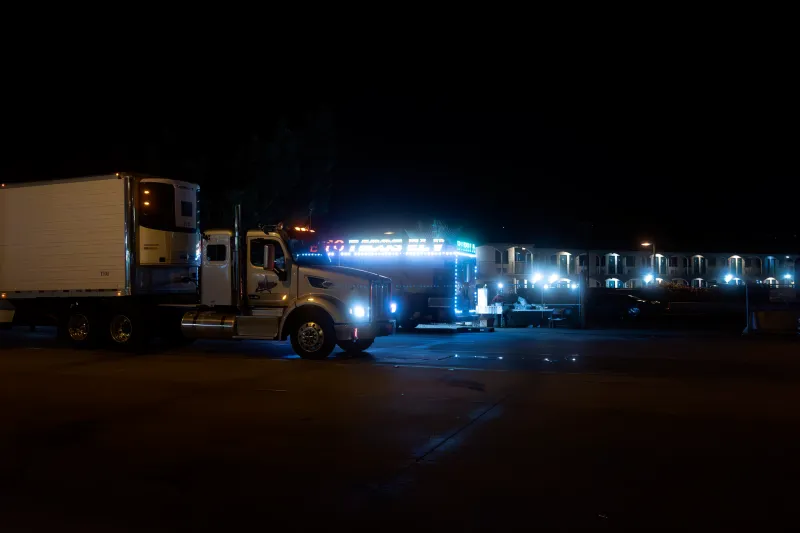
Walk through any truck stop in America at 2 a.m. and you'll see it: rows of semi-trucks, engines running, cabs lit up, nobody moving anywhere. Drivers staying warm or cool, keeping the sleeper comfortable, maybe running accessories. It's a completely normal scene — and for fleet operators, it's a slow financial leak that adds up faster than most people realize.
Idling isn't just a fuel cost. It's an engine wear cost. It's an emissions equipment cost. It's a compliance cost in some states. And when you start adding those numbers together across a fleet of any meaningful size, the total has a way of getting uncomfortable fast.
Let's put some actual numbers on this.
The Fuel Cost — Where Most Operators Start
A typical Class 8 diesel engine burns roughly 0.8 to 1.0 gallons of fuel per hour at idle. That number varies based on engine size, idle RPM, whether the HVAC system is running, and ambient temperature. But 0.8 gallons per hour is a reasonable working baseline for most applications.
At $4.00 per gallon — a figure that's been fairly representative of national diesel averages in recent years — that's $3.20 per hour per truck at idle.
Now scale that up:
- One truck idling 8 hours overnight: $25.60 per day
- That same truck over a 250-day operating year: $6,400 in idle fuel alone
- A fleet of 20 trucks at the same rate: $128,000 per year
Those numbers assume relatively modest overnight idling. Fleets operating in extreme climates — hot Texas summers, cold upper Midwest winters — often see significantly higher idle hours because drivers need HVAC to make sleeper conditions livable. Eight hours is probably conservative for many operations.
At 10 hours of daily idle time, that 20-truck fleet is burning closer to $160,000 per year in idle fuel. Just fuel. Nothing else counted yet.
Engine Wear: The Cost Nobody Puts on the Spreadsheet
Here's where the real money hides. Fuel costs are visible — they show up on your fuel card statements. Engine wear from idling is invisible right up until it becomes a repair bill.
Diesel engines are designed to operate under load. At idle, combustion temperatures are lower, fuel doesn't burn as completely, and oil pressure is reduced compared to operating conditions. The result is accelerated wear on cylinder walls, piston rings, and valve components over time — particularly in cold weather when the engine never fully reaches operating temperature.
The trucking industry has a rough rule of thumb: one hour of diesel engine idling is equivalent to approximately 25 miles of driving in terms of engine wear. Some engineers put that number higher, closer to 30 to 40 miles per hour in terms of wear impact.
Using the 25-mile equivalent as a conservative estimate: a truck that idles 2,000 hours per year is accumulating the equivalent of 50,000 additional miles of engine wear — without moving an inch. On a truck with a 1,000,000-mile engine rebuild interval, that's meaningfully shortening the time between major services.
Engine rebuilds on heavy-duty diesels don't come cheap. Depending on the engine, a major overhaul runs $15,000 to $30,000 or more. Compressing the interval between those rebuilds by 10 to 15 percent through excessive idling represents real money when amortized across a fleet.
Emissions Equipment: The Expensive Victim of Low-Load Operation
Modern heavy-duty trucks equipped with diesel particulate filters (DPFs) and selective catalytic reduction (SCR) systems have an additional idling vulnerability that older fleets didn't face.
DPFs are designed to regenerate — burn off accumulated soot — at elevated exhaust temperatures that occur during normal highway operation. Extended idling produces exhaust temperatures that are too low for passive regeneration to occur. The result is DPF loading, which triggers forced active regenerations that burn additional fuel and stress the filter. Over time, excessive idle-driven DPF loading accelerates the need for manual filter cleaning or replacement.
DPF cleaning runs $300 to $600 per event. Replacement can exceed $3,000 to $5,000 for a quality unit on a Class 8 truck. For a fleet with high idle hours, this maintenance line item can be significantly higher than it needs to be.
SCR systems that rely on DEF injection are also affected by low-temperature operation. Incomplete DEF decomposition at low exhaust temps can lead to deposit buildup in the SCR catalyst, reducing its effectiveness and eventually requiring cleaning or replacement.
Building Your Fleet's Idle Cost Calculator
Every fleet's idle cost profile is different, but here's a straightforward framework for calculating your own numbers:
Step 1 — Establish baseline idle hours. Most modern fleet telematics systems track idle time directly. If you don't have telematics, driver logs and fuel consumption analysis can provide a rough estimate. Target a 30-day sample across your fleet.
Step 2 — Calculate fuel cost. Multiply average idle hours per truck per day × fuel burn rate (0.8–1.0 gal/hr) × current diesel price × number of operating days × number of trucks.
Step 3 — Estimate engine wear cost. Convert idle hours to equivalent mileage (multiply by 25). Divide by your target rebuild interval in miles. Multiply by the estimated cost of a major engine service. This gives you an annualized wear cost attributable to idling.
Step 4 — Add emissions equipment costs. Review your DPF cleaning and replacement history. Estimate what portion is attributable to idle-driven loading versus normal operation.
Step 5 — Total and divide per truck. The per-truck annual idle cost is often the number that motivates change — it makes the investment in idle reduction technology easy to justify.
Practical Idle Reduction Strategies That Actually Work
The good news is that idle reduction is one of the more tractable cost problems in fleet management. The solutions exist, they're proven, and the ROI is usually straightforward.
Auxiliary Power Units (APUs) are diesel or battery-powered units that provide HVAC and electrical power to the sleeper cab without running the main engine. Diesel APUs typically burn 0.2 to 0.3 gallons per hour — a 70 percent reduction in fuel cost compared to main engine idling. Payback periods of 18 to 30 months are common for high-idle fleets.
Idle shutdown policies with telematics enforcement set automatic engine shutdowns after a defined idle period (typically 5 to 10 minutes) and track compliance. Driver behavior changes quickly when idle time is visible and tracked.
Driver education that connects idle costs directly to fleet performance metrics — and where relevant, driver incentive programs — consistently reduces idle hours in fleets that implement them.
Shore power connections at terminals and truck stops allow drivers to plug in for HVAC and electrical needs without running any engine at all. The infrastructure investment is real, but for high-dwell locations, the operating savings justify it.
The Bottom Line
Idling feels passive. Nothing's breaking, nothing's moving, nothing seems wrong. But for every hour those engines run without going anywhere, you're spending money on fuel, shortening engine life, stressing emissions equipment, and in some states, risking compliance penalties.
The operators who treat idle reduction as a serious fleet management priority — not just a feel-good environmental initiative — are consistently finding thousands to tens of thousands of dollars per year in recoverable costs. That's not hypothetical. It's arithmetic.
Run the numbers on your own fleet. The results tend to be motivating.